Geotechnical Digital Twin, Part II
Machines Maintain Continuity. Humans Resolve Ambiguity.
I13 · Alex Vyazmensky · August 2026
In the first part of this digital twin series, I argued that a geotechnical digital twin should be more than a digital representation of the ground.
A 3D model is useful. A monitoring dashboard is useful. A numerical model that is periodically recalibrated against observations is useful. However, none of these, by themselves, necessarily constitute a digital twin.
A more demanding view is that the twin should maintain a continuing relationship between the physical mine, our technical interpretation of it, and the decisions that follow.
That leaves a harder question - What should such a system eventually become?
The mine keeps revealing itself
Mining has a peculiar characteristic. We make important engineering decisions about a system that is only partly known, and then excavation gradually reveals more of the system we were trying to understand in the first place.
Structures appear.
Groundwater behaves differently from what was expected.
Stress conditions evolve.
Rock mass behaviour emerges at scales that were difficult to infer from drilling and testing alone.
Some observations strengthen the existing interpretation. Others weaken it.
Occasionally something appears that forces us to reconsider the problem altogether.
This is why I have difficulty thinking of a geotechnical model as a finished description of the ground. It is better regarded as our current interpretation.
That interpretation can be sophisticated, carefully calibrated and supported by substantial data.
It is still provisional. This is not a weakness of geotechnical engineering. It is simply the nature of working with a partially observable natural system.
A useful digital twin therefore has to evolve with the mine. Not merely by changing geometry or updating monitoring plots, but by helping us maintain the quality of the interpretation on which engineering decisions depend.
Prediction is not enough
Digital-twin discussions naturally gravitate toward prediction.
More monitoring.
Faster data.
Better calibration.
More sophisticated models.
Continuous forecasts.
There is obvious value in all of this, but I am not convinced that better prediction is the most important destination.
Some geotechnical uncertainty is reasonably quantifiable. Material properties can be represented by ranges and distributions. Sensitivities can be explored. Alternative loading conditions can be analysed.
Some of the uncertainty that matters most is conceptual:
Do we have the correct structural interpretation?
Are we modelling the relevant mechanism?
Does the assumed hydrogeological connection actually exist?
Are observations that appear anomalous really noise, or are they telling us that the model is incomplete?
A model can become more precise without our understanding becoming proportionally better.
The more interesting question may therefore be not
How accurately can we predict what happens next?
but
How do we keep the decision appropriate as our understanding changes?
That is a different objective and it shifts the emphasis from prediction alone toward adaptation.
Monitoring the ground and our understanding of it
Conventional geotechnical monitoring is mainly concerned with changes in the physical system.
Has displacement accelerated?
Has pore pressure increased?
Has a trigger level been exceeded?
These remain essential questions.
The engineering interpretation can change before any conventional alarm threshold is reached.
A newly exposed structure may weaken confidence in an assumed mechanism.
A groundwater response may remain within operational limits while behaving differently from what the conceptual model predicted.
A mine-plan change may take the operation into conditions that were not contemplated when an earlier geotechnical assessment was made.
Nothing has necessarily failed, the mine may still be operating normally. Something important has happened, the basis of an earlier decision may no longer be as strong as it was.
This, to me, is where the idea of an adaptive geotechnical digital twin becomes more interesting. Not simply a system that tells us the ground has changed. A system that helps us recognize when new observations should make us reconsider our current understanding of the ground.
The overlooked constraint may be attention.
Experienced geotechnical engineers already do much of this:
We hold mental models of the mine.
We remember why particular assumptions were adopted.
We notice when observations do not quite fit expectations.
We connect geology, hydrogeology, modelling, monitoring, planning and operations.
And, importantly, we exercise judgement about when a discrepancy matters enough to revisit an earlier interpretation or decision.
A difficult work indeed. Not because the number of relevant variables is impossibly large. Usually it is not. The difficulty is maintaining the relationships between them while also doing everything else required in an operating mine.
Engineering review is necessarily selective and often periodic:
We inspect.
We review monitoring.
We meet.
We update models.
We investigate anomalies.
We revisit decisions when sufficient evidence accumulates.
That periodicity provides discipline. Not every new data point should cause the engineering interpretation to change. However, it also creates a practical limitation - weak signals, inconsistencies and changing relationships between information can sit unnoticed between formal review points.
The limiting resource in a continuously adaptive geotechnical system may therefore not be data.
It may not even be computation. It may be human attention.
This is where AI becomes interesting.
I remain cautious about claims that AI is about to replace engineering judgement. Geotechnical engineering is particularly resistant to that simplification.
The ground is only partly observable:
Interpretation matters.
New mechanisms can emerge.
The consequences of being wrong can be significant.
However, there is another, less dramatic way in which AI may become useful:
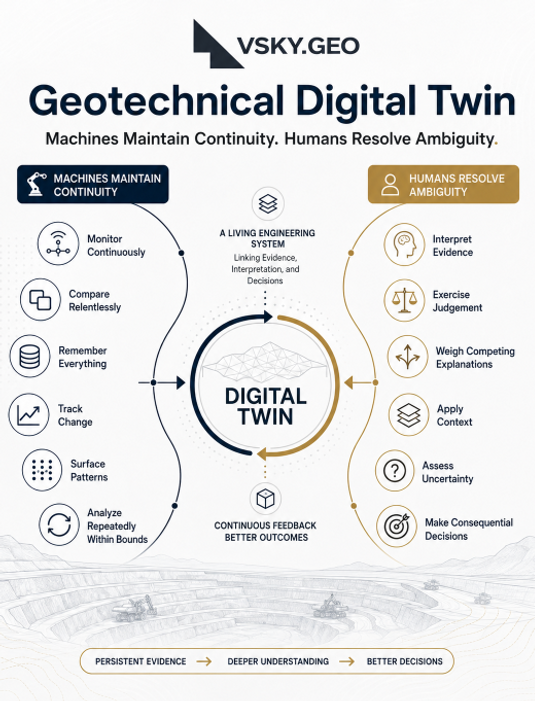
Machines are well suited to tasks that require persistence:
They can compare continuously.
Retrieve large amounts of historical information.
Search for inconsistencies.
Track changes.
Repeat bounded analyses.
Surface patterns that a busy engineer may not have been looking for at that moment.
Perhaps the near-term value of AI in geotechnical engineering is therefore not that it can replace the engineer. It is that it can continuously track changes, compare new evidence with what was previously understood, and bring potential inconsistencies to the engineer’s attention.
Toward bounded autonomy.
Once parts of technical work become machine-assisted, the digital-twin question changes again.
An automated planning system might generate a technically attractive mining sequence very quickly, but should it assume that all of the geotechnical conditions behind that sequence remain valid?
An analytical system might identify an unusual deformation pattern, but is that pattern a known response, measurement noise, or something that deserves reinterpretation?
A modelling system might be capable of running hundreds of scenarios, but which ones are meaningful? And when should it stop and ask for an engineer?
These are not simply computational questions. They are questions about engineering validity and judgement.
For that reason, I find semi-autonomous engineering a more useful idea than autonomous engineering.
Some activities appear naturally suited to persistent machine assistance:
Monitoring.
Comparison.
Retrieval.
Routine consistency checks.
Repeated calculations.
Bounded scenario generation.
Other activities remain very different:
Recognizing a genuinely new mechanism.
Choosing between competing geological interpretations.
Deciding that the conceptual model itself needs to change.
Accepting consequential departures from established assumptions.
Those are not merely information-processing tasks. They are acts of engineering judgement.
The division may eventually be quite natural: machines maintain continuity, while humans resolve ambiguity.
That strikes me as a much more plausible direction than the idea of an autonomous geotechnical engineer.
Perhaps the digital twin is a bridge.
This also changes how I think about the digital twin itself. Perhaps it does not need to become the “intelligent” component of the system and its role is more fundamental.
It may become part of the technical foundation that allows human reasoning, models, monitoring systems and increasingly machine-assisted workflows to remain connected to the evolving reality of the mine.
The detailed architecture for doing that is far from settled. I would be very cautious about automating geotechnical workflows simply because automation has become possible.
Poorly structured engineering does not become better engineering because it is automated.
If anything, automation can amplify weak assumptions more efficiently.
The transition therefore has to be gradual. Engineering maturity first. Automation second.
Human authority must remain explicit where interpretation is uncertain and consequences are material.
The more interesting question.
The more I think about this, the less convinced I am that the digital twin itself is the final destination.
It may be a bridge.
A bridge between today's collection of geological models, numerical analyses, monitoring systems and periodic engineering reviews, and a future in which parts of technical work are performed continuously with machine assistance.
If that happens, the important question may no longer be:
How accurately does the digital twin represent the mine?
It may instead become:
What has changed and does it require us to reconsider our interpretation or course of action?
This question is not uniquely digital. It is fundamentally geotechnical and it goes directly to interpretation, uncertainty and judgement. It leads to a set of questions that I think the profession should begin considering seriously:
How much engineering interpretation can safely be automated?
How should uncertainty constrain machine-generated recommendations?
Where should automation stop?
What level of technical assurance is appropriate when AI contributes to a consequential engineering decision?
And, how do we preserve professional accountability as parts of engineering become increasingly machine-assisted?
I do not think we have complete answers yet. I suspect these questions are closer to the future of the geotechnical digital twin than another generation of increasingly sophisticated dashboards.
The first digital twins were about connecting the physical mine with a digital representation.
The next generation may be about maintaining a more continuous connection between evidence, interpretation and decision.
Beyond that may lie a different kind of engineering system, the one in which machines contribute persistence and scale, while humans retain responsibility for the ambiguity that cannot safely be automated.
The true challenge will not be making geotechnical engineering autonomous, but knowing where autonomy helps and where judgement must remain firmly human.

Share this Insight
Cite this Insight
Vyazmensky, A. (2026). Geotechnical Digital Twin, Part II. VSKY.GEO Insights, I13. www.vskygeo.com