Numerical Modelling is Commonplace. Rigour Has Not Kept Pace
I05 · Alex Vyazmensky · May 2026
Numerical modelling is an essential part of modern mine geotechnical engineering. The issue is not whether models should be used, but how much confidence their inputs, assumptions, calibration and predictions can reasonably justify.
The position taken here is model-literate and model-demanding, not model-sceptical. Good models can materially improve engineering decisions. However, their value depends on understanding what they represent, how they have been constructed, how they have been tested, and where their limitations matter.
The accessibility of geotechnical numerical modelling in mining has grown significantly. Advanced software, training and integrated workflows have made sophisticated analysis accessible to a much broader group of engineers, moving numerical modelling beyond a niche specialty.
However, making the tools easier to use does not make the engineering easier.
Software Proficiency vs. Engineering Insight
Operating the software is not the main challenge. The true difficulty lies in the surrounding judgment: framing questions, building valid ground models, selecting constitutive laws, and knowing when a result is reliable enough for high-stakes decisions. Those are engineering questions, not software questions.
Models as Decision Support Tools
Simulations aid decisions; they do not dictate reality. Their credibility depends on a clear intended use, physically plausible mechanisms, adequate verification, transparent calibration and validation, and explicit treatment of uncertainty.
Following VVUQ principles, a model is only credible for its specific task. It guides choices without ever being absolute truth.
There is a more fundamental question than how sophisticated a model should be: what should the model be expected to do given the available evidence?
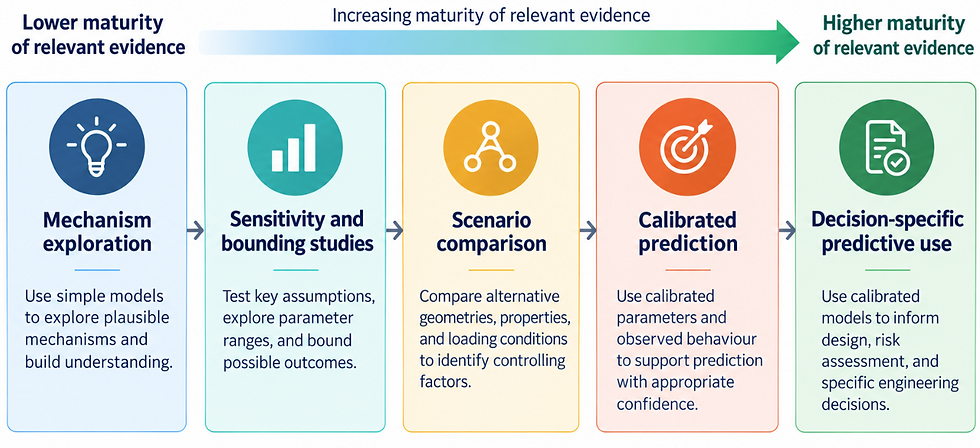
In data-limited systems, numerical modelling may be most credible as a means of exploring mechanisms, sensitivities and cause-and-effect relationships rather than producing direct quantitative predictions. As observational evidence grows, calibration and reconciliation may justify progressively stronger predictive claims.
Model sophistication should therefore follow the maturity of the evidence (as shown in the figure below). Adding detail that the available data cannot constrain does not necessarily increase understanding; it may simply make uncertainty harder to see.
The real test is not whether the model produces a believable deformation field or a convincing Factor of Safety. It is whether the engineering decision remains defensible if the model is partly wrong. That requires sensitivity testing, uncertainty treatment, review, traceability, and continued comparison with field behaviour.
When the Model Becomes Too Expensive to Explore
A high-fidelity model may represent geometry, sequencing and mechanical interaction extremely well, yet become so expensive to build, run and interpret that only a small number of scenarios can realistically be tested. The model becomes more sophisticated while the uncertainty around it may be explored less thoroughly.
This creates a trade-off between model fidelity and model exploration. If only a handful of runs are practical, computational cost begins to influence which assumptions are tested. Stress, groundwater, structural interpretation, material behaviour or sequencing may remain largely unexplored, not because they are unimportant, but because the model is too expensive to explore .
A model explored through only a few carefully selected runs can appear highly rigorous while leaving much of the plausible uncertainty space untouched.
Model complexity should therefore be judged not only by what the model can represent, but also by whether the assumptions that matter can still be challenged.
Capability vs. Geological Reality
Modern numerical tools can represent complex geometry, material behaviour and excavation sequences with impressive detail and speed. The geological system they represent is much less certain.
Rock masses are heterogeneous. Structural controls are incompletely observed. Groundwater conditions are imperfectly constrained. Important behaviour may depend on features that are only partly known.
This creates a fundamental asymmetry: the model can be more detailed than the knowledge supporting it. A polished output can therefore convey more certainty than the underlying information justifies.
It is important to aknowledge that numerical models are representations of our current understanding, not replicas of reality.
Advocating for Formal Discipline
When advanced numerical tools were less accessible, the technical barrier itself imposed some informal discipline. The people using them had usually spent considerable time learning not only the software, but also the assumptions, limitations and habits of interpretation around it.
As tools became easier to acquire and operate, that informal filter weakened. What should replace it is stronger formal discipline:
-
clearer intended-use definitions;
-
explicit uncertainty treatment;
-
sensitivity testing;
-
independent review;
-
traceable assumptions;
-
comparison with field evidence;
-
and last, but not least, appropriate technical competency of the modeler.
Ease of use should not reduce technical discipline.
Governance in Geotechnics
Poor modelling practice can look convincing until it is tested by unexpected behaviour or failure.This is not a critique of modelling, but a call for professional discipline. While tools are simpler to run, building credible models and defining decision boundaries remains difficult.
The objective is not to make modelling harder. It is to make the reasoning behind consequential models visible enough to test.
Share this Insight
Cite this Article
Vyazmensky, A. (2026). Numerical modelling is commonplace. Rigour Has Not Kept Pace. VSKY.GEO Insights, I05. www.vskygeo.com